
Poker Ranges: The Complete Guide to Preflop Ranges (With Charts)
Stop playing your hand — play your range. What ranges are, how they're built, how to read a chart, what linear and polarized mean, and how to memorize ranges without rote learning.
Lou · · 3 min
The sharpest line between a stuck player and an improving one comes down to one word: ranges. The first plays HIS hand. The second plays entire distributions of hands — his own and his opponent's. This guide lays the concept flat: what a range is, how preflop ranges are built, how to read a chart, and how to make them stick for good.
What is a range in poker?
A range is the complete set of hands a player can hold in a given situation. When you open the button, you're not opening “a hand” — you're opening every hand you'd make that move with, and your opponent reasons against that entire set. Modern poker is played range versus range: your actual cards are just one random draw from your distribution.
It's a mental software update: instead of “I have ace-queen, what do I do?”, the real question becomes “which part of my range opens here, and is ace-queen in it?”. The second question has a computable answer. The first leads to guessing.
How preflop ranges are built
Three factors shape your preflop range, in order of importance:
- Position: the later you act, the wider you open — under the gun opens roughly 15% of hands, the button more than 40%.
- Stack depth: at 100 big blinds, speculative hands (small pairs, suited connectors) gain value; at 20 big blinds, high cards dominate and push-or-fold takes over.
- The action before you: opening is one range, flat-calling another, 3-betting a third — each tighter than the last.
How to read a range chart (the 13×13 grid)
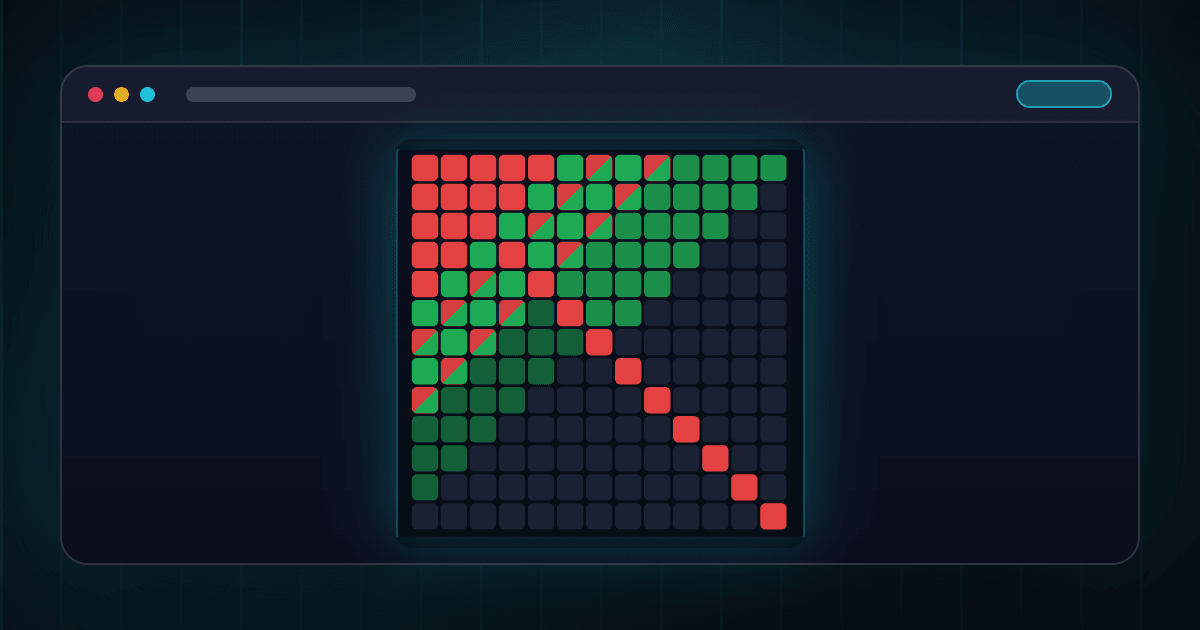
A range chart is a 169-cell grid: pairs on the diagonal, suited hands above it, offsuit hands below. Each cell is colored by action — open, call, 3-bet, fold — sometimes with mixed frequencies (“AJo: 3-bet 50%, call 50%”). A typical button open at 25 big blinds reads: every pair, every ace, most broadways, plenty of suited connectors. If it looks wide, that's because it should be: in position, almost everything plays well.
Linear, polarized, capped: the three range shapes
- Linear: the best hands with no gaps — the classic shape of an opening range or value-heavy 3-bet.
- Polarized: very strong hands plus bluffs, nothing in between — typical of a light 3-bet or a big river bet.
Turn theory into reflexes
Solver ranges, ICM spots, instant feedback. Train 20 minutes a day on real hands.